
Crocodile and Plover AI Video Prompt: Create a Tense 10-Second Wildlife Scene
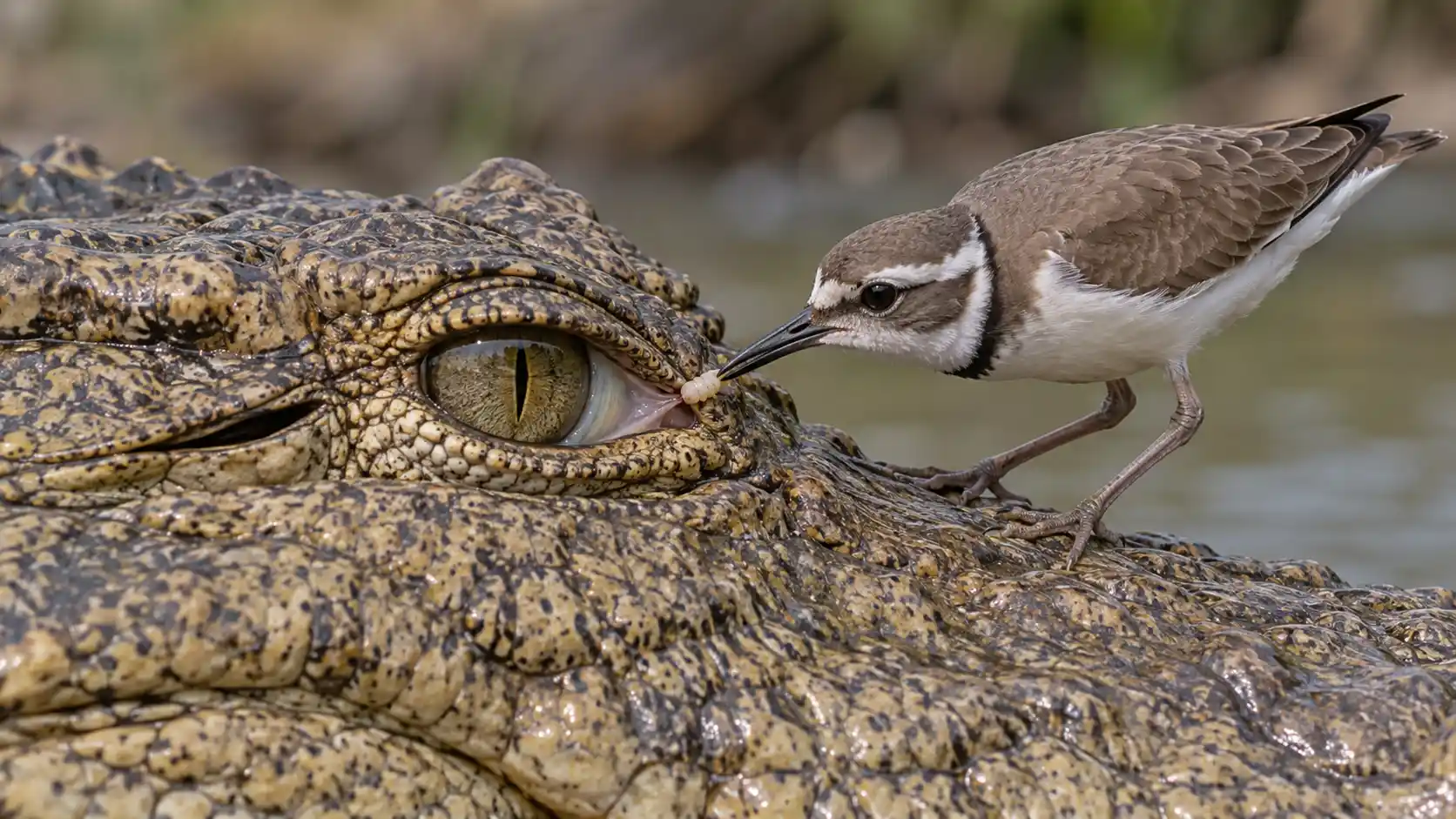
A tiny bird braces its feet against a crocodile’s scales. Its beak is gripping something hidden beneath the inner eyelid. It pulls backward—but whatever it has caught refuses to come free.
Another tug. A brief slip. Then the bird grips again.
Will the next pull finally release it?
That unanswered question drives this crocodile and plover AI video concept. The action begins in the very first frame, develops through a difficult extraction, and builds toward one final pull—all within a continuous, extreme close-up.
If you arrived from our Instagram reel looking for the prompt, you’re in the right place. Below, you’ll find the complete original AI video prompt, followed by a scene breakdown, practical generation tips, and a checklist for reviewing your results.
Creative context: This is an imagined AI-generated wildlife sequence presented in a documentary visual style. It is not recorded wildlife footage or evidence of the animal behavior depicted.
What Does This AI Video Prompt Create?
The prompt describes a ten-second scene featuring one Nile crocodile, one plover, and one hidden larva. The camera stays close to the crocodile’s eye as the bird makes repeated attempts to extract the larva.
The intended look is restrained and observational: natural daylight, realistic surface textures, subtle handheld movement, and ordinary environmental reflections.
The central challenge is continuous physical contact. The bird must remain connected to the larva, each pull must produce gradual progress, and the eye membrane must remain intact throughout.
| Prompt detail | Specification |
|---|---|
| Duration | 10 seconds |
| Aspect ratio | 16:9 |
| Visual direction | Raw wildlife documentary style |
| Framing | Extreme close-up |
| Shot structure | One continuous, uninterrupted shot |
| Subjects | One Nile crocodile, one plover, one larva |
| Story progression | Initial grip → resistance → repeated pulls → final extraction |
| Audio direction | Scripted voice-over; no background music |
Complete Original Crocodile and Plover AI Video Prompt
Copy the entire prompt below, including the camera instructions, realism requirements, and negative prompt.
🐊NILE CROCODILE × PLOVER — RAW DOCUMENTARY EXTRACTION
FORMAT: 10 seconds | 16:9 | RAW WILDLIFE DOCUMENTARY
VISUAL STYLE: Authentic raw wildlife-documentary footage captured in natural daylight with a professional long-lens macro wildlife camera. No cinematic beautification, no stylized lighting, no artificial HDR look, no exaggerated colors. Natural exposure, realistic shadows, natural reflections, slightly imperfect handheld field-camera movement, subtle focus breathing, genuine wildlife-camera behavior. The footage must feel like a real moment captured by a wildlife documentary crew in the field.
0:00–0:02 — INSTANT HOOK
Start mid-action from the very first frame.
Extreme close-up of one adult Nile crocodile’s eye. Its natural translucent inner eyelid/nictitating membrane is intact.
A single Plover is already positioned at the eye, with its beak physically tucked beneath the inner eyelid and gripping one hidden larva.
The Plover immediately pulls backward.
The crocodile’s eye reacts naturally.
🎙️ VOICE-OVER:
“Behind the crocodile’s eye… a hidden enemy has just been caught.”
0:02–0:04 — HARD FIRST PULL
The Plover braces its feet against the crocodile’s natural facial scales and pulls with increasing force.
The larva remains mostly hidden because of strong physical resistance.
The bird’s body visibly strains backward while maintaining its grip.
🎙️ VOICE-OVER:
“Now comes the fight… because this parasite refuses to let go.”
0:04–0:08 — POWERFUL EXTRACTION STRUGGLE
The Plover makes several realistic extraction attempts.
First pull: strong backward tug; only the smallest portion emerges.
Second pull: the beak slips slightly, then the Plover immediately re-grips.
Third pull: the bird braces harder and pulls again, gradually exposing more of the larva.
Fourth pull: maximum sustained effort; the bird leans backward while maintaining a firm grip.
The larva progresses naturally:
HIDDEN → TINY TIP → SMALL SECTION → HALF VISIBLE.
The larva never crawls or moves independently. Every movement comes directly from the Plover’s pulling force.
🎙️ VOICE-OVER:
“It slips… it grips again… and this time, it pulls with everything it has.”
0:08–0:10 — FINAL EXTRACTION
The Plover secures its strongest grip.
It braces against the crocodile’s scales.
A brief moment of maximum resistance—
Then ONE POWERFUL FINAL PULL.
The complete larva is physically pulled free from beneath the intact inner eyelid.
The Plover immediately swallows the larva.
The crocodile’s nictitating membrane naturally settles back over the eye.
🎙️ VOICE-OVER:
“THE FINAL PULL… AND THE HIDDEN THREAT IS FINISHED.”
RAW REALISM LOCK
Exactly ONE Nile crocodile, ONE Plover, ONE larva.
Realistic crocodile anatomy, realistic Plover anatomy, realistic beak-to-membrane interaction, realistic physical resistance, natural animal reactions.
The inner eyelid remains intact throughout. NO cavity, NO hole, NO wound, NO blood, NO gore, NO torn tissue.
The larva cannot move independently. It can only move as a direct physical consequence of the Plover gripping and pulling it.
The extraction must be gradual and physically connected from beginning to end.
CAMERA LOCK
One continuous uninterrupted raw documentary shot.
Extreme close-up throughout.
Natural field-camera movement, subtle handheld instability, realistic autofocus behavior, slight focus breathing, natural daylight, authentic exposure changes, real-world color balance, natural environmental reflections.
No cinematic camera moves, no artificial slow motion, no dramatic lighting, no CGI polish.
The footage should look like unedited raw wildlife documentary material captured in the field.
STRICT NEGATIVE PROMPT
Cinematic stylization, Hollywood lighting, artificial HDR, oversaturated colors, glossy CGI look, perfect studio lighting, slow setup, independent larva movement, crawling larva, self-emerging larva, instant extraction, effortless extraction, weak pulling, oversized larva, duplicate larva, extra bird, extra crocodile, eye cavity, hole, wound, blood, gore, torn membrane, damaged tissue, exposed eyeball, unrealistic anatomy, membrane morphing, teleportation, disappearing larva, jump cuts, transitions, camera resets, wide shot, dramatic zoom, artificial slow motion, focus jumps, impossible physics, text, subtitles, background music.
How the Scene Builds Suspense in Just 10 Seconds
The sequence gives the viewer one action to follow, then changes the situation slightly with each attempt. Here is how its four stages work together.
1. The First Two Seconds Create an Immediate Question
The scene opens with the bird already gripping and pulling. There is no slow approach or landscape introduction.
That makes the first frame important. The viewer needs to see enough of the beak, eye, and pulling motion to understand that something is happening—even before the hidden larva becomes visible.
When reviewing your generation: Check whether the first second contains a clear action. A motionless opening misses the intended hook.
2. Resistance Gives the Action Weight
During the next two seconds, the bird braces against the crocodile’s scales and pulls harder. The larva stays mostly hidden.
The visual task is to communicate effort through the bird’s posture and the limited movement of the object. If the larva slides free immediately, the scene loses the struggle described in the prompt.
When reviewing your generation: Watch the feet and body together. The bird should appear supported as it leans backward.
3. Repeated Pulls Create Visible Progress
The middle section contains the most detailed movement: a tug, a slight slip, a renewed grip, and another sustained pull.
The larva’s gradual reveal gives the viewer something specific to track. Each attempt should move the scene forward while preserving the connection between the beak and the larva.
When reviewing your generation: Follow the contact point. Look for sudden changes in position, size, or attachment during the re-grip.
4. The Final Pull Resolves the Struggle
The last two seconds complete the action that began in the opening frame.
The intended ending includes extraction, swallowing, and the membrane settling. Those movements need to remain readable in a very short window.
When reviewing your generation: Check that the final extraction is visible. An object disappearing between frames does not communicate the same resolution.
How to Use This AI Wildlife Video Prompt
Step 1: Copy the Complete Prompt
Include the full scene description, timing, voice-over, realism lock, camera lock, and negative prompt.
The final sections contain instructions that matter to the whole sequence, including subject count, membrane integrity, and continuous camera framing.
Step 2: Match the Available Video Settings
Where your generator supports them, select:
- Duration: 10 seconds.
- Aspect ratio: 16:9.
- Audio: According to the generator’s available voice-over controls.
Available settings vary by tool. Treat the supplied prompt as the creative brief and check which parts your generator can control directly.
Step 3: Handle the Negative Prompt According to Your Tool
If your generator provides a dedicated negative-prompt field, place the original negative-prompt text there without rewriting it.
If there is no separate field, retain the exclusions in the main prompt. Their effect will depend on how the generator interprets instructions.
Step 4: Review the Motion Before the Surface Detail
Start by checking the sequence: grip, resistance, gradual reveal, and final extraction.
Once that sequence is readable, examine textures, lighting, reflections, and camera behavior. A detailed image can still contain broken contact or objects passing through one another.
Step 5: Test the Voice-Over Timing
The original prompt includes four narration passages. Together, they are dense for a ten-second clip.
Listen to the result before publishing. If the narration sounds rushed or gets cut off, keeping every word may require a longer companion edit. The original prompt above remains unchanged.
Common Generation Problems to Watch For
A detailed prompt gives you a clear target, but it does not guarantee that a video generator will follow every instruction.
Use this checklist to assess where a result departs from the intended scene.
| Problem in the generated clip | What to inspect |
|---|---|
| The larva emerges immediately. | Whether the staged reveal and resistance are visible. |
| The larva crawls out by itself. | Whether its movement remains tied to the bird’s pulling. |
| The beak detaches while extraction continues. | Physical contact during each tug and re-grip. |
| Extra animals or larvae appear. | Subject count throughout the entire shot. |
| The eye develops damage or a hole. | Membrane integrity before, during, and after extraction. |
| The shot becomes glossy or heavily stylized. | Color, exposure, lighting, and surface appearance. |
| The camera cuts or suddenly widens. | Continuity of framing from the first frame to the last. |
| The final larva disappears. | Whether extraction and swallowing are actually shown. |
If a result misses several requirements, identify the most significant failure before trying again. That gives you a useful basis for comparing attempts with the same original prompt.
A Simple Two-Pass Review Before Sharing
First Watch: Follow the Story
Play the clip at normal speed and ask:
- Is the action clear immediately?
- Does the struggle show progress?
- Can I see how the extraction ends?
This pass checks whether the ten-second sequence makes sense as a complete viewing experience.
Second Watch: Follow the Contact Points
Watch again, focusing on the bird’s feet, the beak, the larva, and the membrane.
Look for sliding feet, shifting anatomy, sudden size changes, or broken contact. If needed, pause around the re-grip and the final pull.
The re-grip is particularly useful to inspect because it asks the generation to change the bird’s action while preserving the position of everything around it.
Sharing Your Result on Instagram
The supplied prompt uses a horizontal 16:9 composition. If you prepare a vertical version, preview the crop carefully.
Keep the bird’s beak, the crocodile’s eye, and the extraction point visible together. A tight crop that removes one of those elements can make the action difficult to understand.
Clearly label the published result as AI-generated. The documentary appearance is part of the creative direction; it should not be presented as proof that the event was filmed in nature.
For viewers who want to try the concept themselves, link directly to this prompt page so they can find the complete text and review guidance in one place.
Frequently Asked Questions
Is this real wildlife footage?
No. This is a creative prompt for an imagined AI-generated wildlife scene. The requested documentary style describes its appearance.
Does this prompt establish that plovers perform this behavior?
No. The prompt is a fictional visual brief. It does not establish the depicted interaction as documented animal behavior.
What duration and aspect ratio does the prompt specify?
The original prompt specifies 10 seconds in 16:9.
Does the prompt include narration?
Yes. It contains four voice-over passages matched to the four stages of the scene. Direct voice generation depends on your tool’s audio capabilities.
Why does the prompt include a negative section?
It identifies unwanted outcomes, including duplicate subjects, damaged tissue, independent larva movement, camera cuts, and stylized lighting. Whether those exclusions are followed depends on the generator.
Will every attempt produce the same result?
No identical result is promised. Outputs can vary between generations, settings, and models. Review each clip against the original brief.
Can I use the prompt without changing it?
Yes. Copy the complete original prompt above and apply the matching controls your generator supports. The surrounding tips help you evaluate the output without requiring edits to the prompt.
Your Turn: Can You Keep the Action Connected?
The defining challenge in this scene is maintaining one believable chain of movement: the bird grips, pulls, re-grips, and finally extracts the larva while the shot stays continuous.
Try the original prompt, then watch your result closely at the re-grip and final pull.
Which part was hardest to generate—the gradual reveal, the bird’s grip, or the continuous close-up? Tell us in the comments, and share which AI video generator you used.